Case Study

Starz University Mobile App

From a rainy-day challenge to a digital breakthrough, turning a fragmented campus into one dependable place, accessible anytime, on any device.

Mobile appCloud (AWS)Student platformLiberia
The spark

It started with a rainy ride

Two years ago, riding my motorbike to campus, I got caught in heavy rain. By the time I arrived, my student handbook and payment receipts were completely ruined, and there was no way to replace the handbook until the next semester. Standing there soaked, I asked a simple question: how many other students go through this same hassle, and why hadn't the university offered a smarter solution?

That question became the Starz University Mobile App, an app born from a real student's need and crafted to make essential information and services accessible anytime, anywhere. It isn't just an app to save you from soggy papers; it's a tool designed to make university life easier, smarter, and more connected.

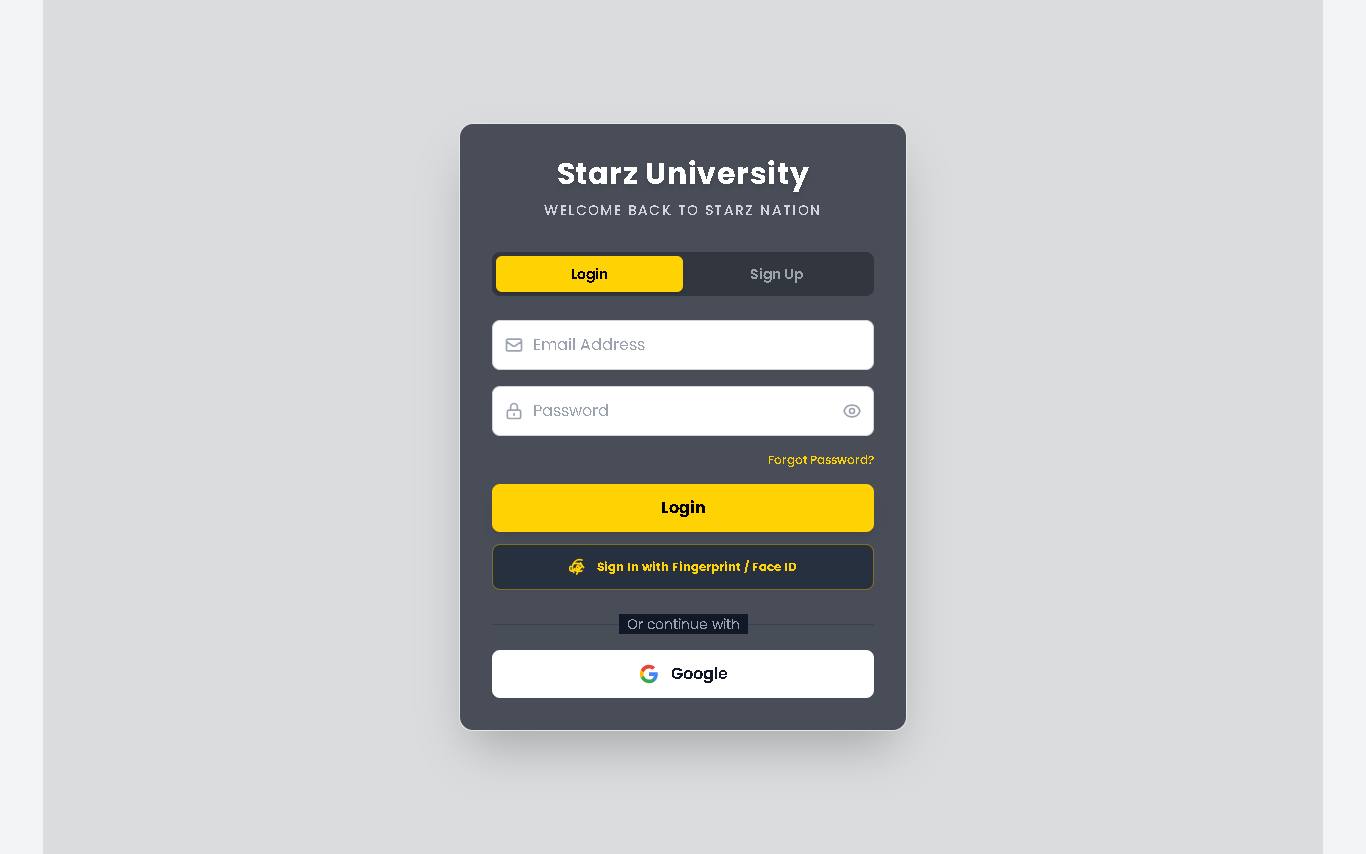
Starz University Mobile App (Starzit), live application
starzit.app, the live application
The problem

A fragmented campus

The problem was never a lack of effort. Like many Liberian organizations, the campus kept operations moving with paper files, spreadsheets, phone calls, WhatsApp messages, personal memory, and constant follow-up.

The real friction was fragmentation: notices, academic information, library resources, social communication, and records all lived in separate places. Students navigated between physical notice boards, separate portals, and unofficial channels just to find or verify a single answer. Methods like these can survive while an organization is small, but growth exposes their weaknesses, information becomes hard to verify, responsibility becomes unclear, and simple questions pass through several people before an answer can be trusted.

A digital platform should not insult the people who managed the old process. It should preserve what works, remove unnecessary friction, and make accountability easier.
The approach

Workflow before features

Before thinking about features, I had to understand the workflow. I kept returning to a set of questions:

  • Who creates the information?
  • Who checks it?
  • Who is allowed to change it?
  • What happens when the internet is slow?
  • What happens when a user makes a mistake?
  • What should management see, and what should stay private?

These aren't decorative planning exercises, they decide whether the final system supports the organization or creates a new kind of confusion. A weak understanding of the workflow cannot be repaired by a beautiful interface. Design can hide confusion for a while, but users eventually feel every unclear rule.

What I built

A comprehensive campus platform: a Progressive Web App with security, a digital library, a student community, and a full administrative suite.

Core Platform & User Experience

  • Progressive Web App (PWA): installable on Android and iOS home screens with full offline caching and service-worker support.
  • Offline mode & sync queue: live offline detection with a background sync indicator and pending-queue count.
  • Adaptive dark & light themes: system-aware and manually toggleable, tuned to campus branding.
  • Role-aware keyboard shortcuts: fast power-user navigation (Alt + H, Alt + P, Alt + L, and more) with separate profiles for students and administrators.
  • Interactive onboarding tour: a "Getting Started" walkthrough through every core tab and shortcut.
  • Session protection: inactivity detection with auto-logout countdown warnings and session-extension options.

Authentication, Security & Digital Identity

  • Multi-role authentication: Supabase-powered sign-in for Students, Staff, Announcers, Executives, and Administrators.
  • Two-factor authentication (2FA): time-based one-time password (TOTP) enrollment with authenticator-app QR codes.
  • Biometric authentication: WebAuthn support for fingerprint, Touch ID, and Face ID.
  • Password management & strength meter: live complexity evaluation, secure reset, and an in-app change modal.
  • Digital student ID card
    • Live, dynamic verification QR code.
    • Photo upload with security and MIME-type validation.
    • Academic level, college, department, ID number, and a real-time clearance-status badge.
  • Active device & session manager: review logged-in devices and trigger remote single or multi-session logouts.

Academic Services & Student Portal

  • Direct gateways
    • Academic Portal: one-tap access to the Starz Access Portal for transcripts, billing balances, and course registration.
    • Online learning (LMS): direct gateway to the Moodle / Sugms e-learning platform for syllabus materials and online exams.
  • Degree audit & GPA tracker: track completed vs. required credit hours, view CGPA, and monitor semester-by-semester completion.
  • Personalized class timetable: daily and weekly views with room locations, instructors, times, and exam-alert notifications.
  • Document repository: upload, store, and access administrative PDFs (building forms, test clearances, tuition receipts).
  • Test & financial clearance: instant visibility into eligibility, clearance percentage, and authorized signatures.

Academic Resources & Digital Library

  • Digital library archive
    • Catalogs by college (Information Technology, Business, Graduate School).
    • Search by title, author, call number, and availability.
    • Built-in HD PDF reader with page navigation and bookmarking.
    • Embedded audio and video players for course recordings and lectures.
  • Official student handbooks: interactive reader with chapter navigation, code-of-conduct guidelines, and downloadable offline copies.
  • Program curriculum guides: full semester breakdowns of requirements, course codes, credits, and prerequisites.
  • Searchable campus FAQ: accordion repository covering admissions, academics, portal access, and financial policies.

StarzConnect: Campus Community & Networking

  • Campus feed: an interactive social wall for discussions, student updates, and peer interaction.
  • Direct & group messaging: private real-time communication between students and study peers.
  • Student communities: topic-based and departmental groups for collaborative study and clubs.
  • Academic Q&A hub: a peer question-and-answer forum with upvoting and verified responses.
  • Student connections: discover classmates, follow academic peers, and expand campus networking.
  • Community moderation: an admin dashboard to review reported content and control feature availability.

Communications, Feedback & Events

  • Communication hub: a centralized notifications drawer with search, unread counters, and real-time alerts.
  • Official announcements: university-wide broadcasts with individual read / unread tracking.
  • Administrative signals & direct messages: official department communications with file attachments and voice recordings.
  • Campus-wide voting polls: interactive voting with instant cryptographic recording and real-time tallies.
  • Grievance & feedback portal: a support-ticket system for issues, inquiries, or suggestions, with status updates.
  • University events calendar: a schedule by Academic, Sports, Deadlines, and General, with countdowns and venue details.

Executive Intelligence & Administrative Suite

  • Executive analytics dashboard: charts for user growth, department distribution, login trends, and system utilization.
  • Student directory & account control: search, edit academic standing, assign roles, and export the directory to CSV.
  • Incomplete-profiles manager: automated detection and resolution of missing profile details.
  • Clearance management center: issue exam clearances, set durations and thresholds, and upload signee signatures.
  • Announcement publisher: compose and schedule broadcasts to the whole student body.
  • Event planner: create, edit, and categorize campus events and deadlines.
  • Library curator: upload textbooks, update catalog status, assign call numbers, and manage PDFs.
  • Poll control center: create opinion polls, configure options, and toggle visibility.
  • Program & course manager: update curriculum, add semester courses, and edit descriptions.
  • Tamper-evident audit trail: logs of sensitive actions, edits, and logins with CSV export.
  • Recycle bin & safe restore: a soft-deletion archive to restore accidentally removed records.
  • GUI & branding settings: customize logos, signee titles, contacts, and toggle system modules.
Under the surface

Architecture & engineering

The parts users never praise are the parts that decide whether a system lasts. Information needed a clear structure. User roles needed boundaries. Important actions needed validation. Records needed to stay understandable long after the person who created them had moved on, and the system needed room to grow without turning every future improvement into a complete rebuild.

I designed for real conditions, not ideal ones: different devices, different levels of digital confidence, and unreliable internet. And I treated data with respect, every record has a purpose, an owner, an access rule, and a retention plan, backed by backups, audit trails, and clear permissions. The public judges technology by what appears on the screen, but professional responsibility includes what happens behind it.

A fast demonstration can impress people for one day. A thoughtful foundation protects the project for years.
The results

Measurable impact

15,000+
Students & faculty supported
99.9%
Uptime for the Starz App
90%
Lower operating cost (AWS)
6h → 2h
Support resolution time
The lesson

What it taught me

I'm proud of the technical growth, but I value the professional lessons even more. Software development is rarely only about writing code, the real work begins with understanding people, pressure, habits, and the consequences of getting a decision wrong.

Clients and developers often use the same words while imagining different things, so my job is to ask respectful questions and help stakeholders separate symptoms from root causes. I stopped treating revision as proof that the work failed; more often it means the project has moved from assumption to understanding. And completion isn't launch day, adoption, training, maintenance, and support are what turn a product into infrastructure.

The strongest portfolio is not a long list of technologies. It is a record of problems understood and responsibilities handled well.

See it in action

Explore the live Starz University app, or tell me about a system you need built right.

Visit the app