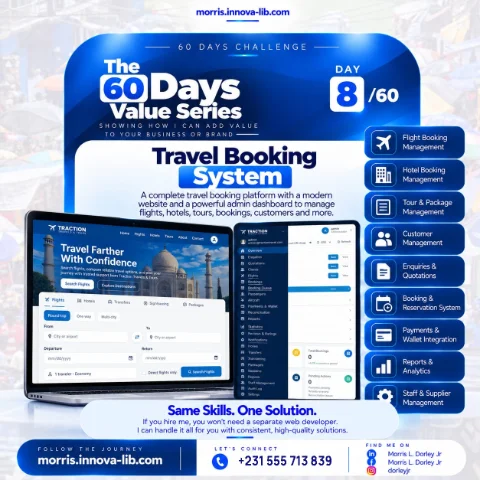

Day 8 of the 60 Days Value Series is about travel businesses. If you hire me, you will not need a separate web developer. I build a complete travel booking platform: a modern website that your customers enjoy using and a powerful admin dashboard that lets your team manage flights, hotels, tours, bookings, customers, payments and reports from one place.
Are bookings still living in WhatsApp chats and notebooks?
A customer sends a message asking about a flight. Someone replies with a price. The customer asks about a hotel. A different person replies. The payment is made, a receipt is written by hand and the booking is noted in a book. Two weeks later nobody can say quickly which customers have paid, which tickets are issued and which quotations are still waiting for an answer.
This is how many travel agencies, tour operators and hotels in Liberia and across Africa still run. It works while the business is small, and it breaks as soon as the number of customers grows. This post is for travel business owners who want a travel booking system in Liberia that makes their business look professional online and run smoothly behind the scenes, with one person responsible for both sides.

What is a travel booking system?
A travel booking system has two connected parts.
- The public website. This is what your customers see. It lets them search for flights, hotels, transfers, sightseeing tours and packages, explore destinations and send a booking request or enquiry. The Day 8 flyer shows an example with a search form for round trip, one way and multi city flights, with departure and return dates and the number of travellers.
- The admin dashboard. This is what your team sees. It collects every enquiry and booking in one place and gives staff tools to prepare quotations, confirm reservations, record payments, manage customers and read reports.
When both parts are built together, the information flows without retyping. A customer request on the website appears in the dashboard. A confirmed booking appears in the customer record. A payment appears in the reports. Nothing depends on someone remembering to copy it.
A travel website that only looks nice is a brochure. A travel website connected to a working dashboard is a business tool that takes enquiries, organizes them and helps you close them.
Why does a travel business need more than a normal website?
A simple five page website tells people who you are. It does not manage the daily work of selling trips. Travel has more moving parts than most businesses: each booking involves a customer, one or more suppliers such as airlines or hotels, dates, prices, passenger details and payments, and every one of those can change. Without a system, the details live in people's heads and phones. With a system, they live in one organized record that every authorized staff member can find.
What nine modules does the Day 8 flyer cover?
The flyer lists nine areas of the admin dashboard. Here is what each one does in plain words.
1. Flight booking management
Flight requests need passenger names, routes, dates, fares and ticket status. This module keeps all of it together. Staff can see which requests are new, which are quoted, which are confirmed and which are ticketed. Instead of searching through chats to find a passenger's details, you open one booking and see everything.
2. Hotel booking management
Hotel reservations have their own details: property, room type, check in and check out dates, number of guests and the agreed rate. This module records each reservation and its status, so you always know which rooms are booked for which customer and which confirmations are still waiting.
3. Tour and package management
Many travel businesses sell packages that combine flights, hotels, transfers and sightseeing. This module lets you create and update packages with descriptions, prices, durations and photos, and publish them on the website. When a price changes or a package sells out, you update it once and the website reflects it.
4. Customer management
Repeat customers are the most valuable ones. This module keeps every customer's contact details, travel history, preferences and notes in one place, so you can serve them faster the second time and follow up when their next trip is likely. Passenger details are stored once instead of being asked for again and again.
5. Enquiries and quotations
Every enquiry from the website lands in a queue. Staff can reply, prepare a quotation and track whether the customer accepted. You can see which enquiries are waiting too long, which ones convert into bookings and which staff member is handling each one. No enquiry gets lost in a busy inbox.
6. Booking and reservation system
This is the heart of the platform. It turns an accepted quotation into a confirmed booking, keeps a booking queue, tracks passengers and updates the status as the trip moves forward. Because the status is visible to the whole team, a customer who calls with a question gets an answer immediately.
7. Payments and wallet integration
Money needs careful tracking. This module records payments, balances, refunds and pending amounts against each booking, and a wallet feature can hold customer or agent balances. Staff can reconcile what has been received with what is owed. The payment methods connected depend on the providers available for your market, and I only integrate options that are properly supported.
8. Reports and analytics
The dashboard turns daily activity into numbers: total bookings, pending actions, payments waiting for review, popular destinations and performance over time. You see what sells, who sells it and where money is waiting, so decisions are based on facts instead of memory.
9. Staff and supplier management
Your business depends on your team and your suppliers. This module manages staff accounts and permissions, so each person sees only what they should, and keeps supplier details such as airlines, hotels and transfer partners. An audit log of important actions helps you see who changed what.
What does the customer see on the website?
A good travel website makes the next step obvious. The visitor lands on a clear headline, a search form and a few strong destination or package options. They can browse flights, hotels, transfers, sightseeing and packages, read about a trip, and send an enquiry or booking request without confusion. The site is fast, readable on a phone and styled in your brand colors, so it feels like your company and not a template. I also write the page titles and descriptions with search in mind, so people searching for travel services can find you. Day 6 of this series explains how that works.
How does a booking move through the system?
- The customer sends an enquiry. They use the website form or search, and the request appears in your dashboard.
- Staff prepare a quotation. The team replies with prices and options from the system.
- The customer accepts. The quotation becomes a booking with passenger and trip details.
- Payment is recorded. The amount, method and balance are saved against the booking.
- The booking is confirmed and tracked. Tickets or vouchers are issued and the status is updated.
- Reports update automatically. Totals and performance are always current.
Why do travel businesses lose money without a system?
- Lost enquiries. A message buried in a chat is a customer who bought elsewhere.
- Pricing mistakes. Quotes copied by hand sometimes carry an old fare or a wrong total.
- Payment confusion. Without one record, it is hard to know who has paid, who owes and who needs a refund.
- Double handling. The same passenger details are typed several times by different people.
- No visibility. The owner cannot see the state of the business without asking everyone.
- Weak online presence. Customers who cannot find or trust your website choose a competitor who looks more established.
How does one person who builds both sides save you money?
A booking platform needs web design, front end development, back end development, database design and often some cloud setup. Many agencies split these between several people. Each handoff adds meetings, delays and misunderstandings, and you pay for all of them.
- One brief. You explain your travel business once.
- The website and dashboard fit together. The same person designs the screens and the data behind them.
- Faster changes. If you want a new package type or a new report, I build it directly.
- A clean, consistent look. The public site and the dashboard share your brand.
- One person to call. When something needs attention, there is no chain of people passing the question around.
What technical foundation is behind the platform?
A booking platform looks simple on screen, but behind it sit a database, secure logins, permissions, forms, notifications and hosting. I am a Cloud Architect and Full-Stack Developer with 90+ web applications built, and I have delivered platforms that serve thousands of users. That experience lets me build the system with security, speed and growth in mind, instead of patching it later. See my skills, read about my experience, browse the case studies, view live work on the projects page and learn more about me. My full-stack development service page describes the kind of work this involves.
Who is this for?
- Travel agencies that sell flights, hotels and packages.
- Tour operators that run sightseeing trips and group tours.
- Hotels and guest houses that want direct online booking requests.
- Airport transfer and car rental services that take reservations.
- New travel startups that want to launch with a professional platform.
How do you know it is time for a booking system?
- You answer the same questions on WhatsApp all day.
- Staff disagree about whether a customer has paid.
- You cannot say how many bookings you made last month without counting by hand.
- Customers ask for a website where they can see your offers.
- You rely on one person who knows where everything is.
- You are afraid of what happens if a notebook or a phone is lost.
What mistakes should you avoid when building a travel platform?
- Building every feature at once. Start with enquiries, quotations and bookings, then add the rest.
- Ignoring the mobile experience. Most visitors will use a phone.
- Skipping permissions. Not every staff member should see payments or change prices.
- Forgetting backups and security. Passenger and payment records are sensitive.
- Copying a foreign site blindly. Your customers, payment methods and processes are local, so the system should fit them.
- Choosing the cheapest builder. A cheap system that breaks during peak season costs far more.
What affects the price of a travel booking system?
Every business is different, so I price to the scope. These things shape the price:
- Which modules you need first and which can wait.
- How many types of services you sell: flights, hotels, tours, transfers, packages.
- How many staff accounts and permission levels are needed.
- Which payment and wallet options you want to connect.
- How much design, content and training is included.
Send me your goals and I will reply with a clear quote.
How does it work?
- Send your brief. Tell me about your services, your team and how you take bookings today.
- Get a plan and quote. I define the modules, screens, timeline and price.
- I design and build. You see progress along the way and can adjust early.
- We test and train. I check every flow, then teach your staff to use the dashboard.
- Launch and support. The platform goes live, and I remain available for changes and improvements.
Which search terms does this post answer?
If you arrived here from Google, you may have searched for one of these: travel booking system Liberia, travel agency website Liberia, flight booking website for Africa, hotel booking system in Monrovia, tour package management software, online booking system for travel agencies, web developer for a travel company in Liberia, or admin dashboard for a travel business. The answer to all of them is the same: send me your brief and I will give you a clear plan and quote.
Ready to run your travel business from one platform?
You do not need a web designer, a back end developer, a database specialist and a dashboard builder working separately. Message me on WhatsApp at +231 555 713 839 or visit the contact page, tell me how your travel business works, and I will respond with the next step. Same skills, one solution, with consistent, high quality work you can use every day.
Tomorrow, Day 9 continues the series. Follow the journey on the blog, Facebook, Instagram and LinkedIn.
Frequently asked questions
What is a travel booking system?
A travel booking system is a website and a management dashboard working together. Customers use the website to search for flights, hotels, tours and packages and to send a booking request or enquiry. Your staff use the admin dashboard to see those requests, prepare quotations, confirm bookings, record payments and follow each customer.
Who needs a travel booking system?
Travel agencies, tour operators, hotels and guest houses, airport transfer services, and any business that sells trips or reservations. If you currently take bookings through phone calls, WhatsApp messages and notebooks, a booking system will save you time and reduce mistakes.
What does the admin dashboard include?
The Day 8 flyer lists the main areas: flight booking management, hotel booking management, tour and package management, customer management, enquiries and quotations, a booking and reservation system, payments and wallet integration, reports and analytics, and staff and supplier management.
Can customers pay online?
Payments and wallet integration is part of the system. The exact payment methods depend on the providers available to you and the countries you serve, so we agree on them together during planning. I only connect payment options that are properly supported.
Will the website work well on a phone?
Yes. Most customers in Liberia and across Africa browse on their phones, so I build the website to be fast and easy to use on small screens as well as on laptops.
Can I manage the system without technical knowledge?
Yes. The dashboard is designed for travel staff, not programmers. I show your team how to add a package, update a hotel, record a payment and read a report.
How much does a travel booking system cost in Liberia?
The price depends on how many services you sell, which features you need first, the number of staff who will use it and any integrations. Send your details on WhatsApp at +231 555 713 839 and I will give you a clear quote for the exact scope.
Can the system grow with my business?
Yes. You can start with the most important modules, such as flights and enquiries, then add hotels, tours, wallets and analytics as your business grows.
Do you work with travel businesses outside Monrovia and outside Liberia?
Yes. I work with clients in Monrovia, across Liberia and across Africa, remotely or in person.