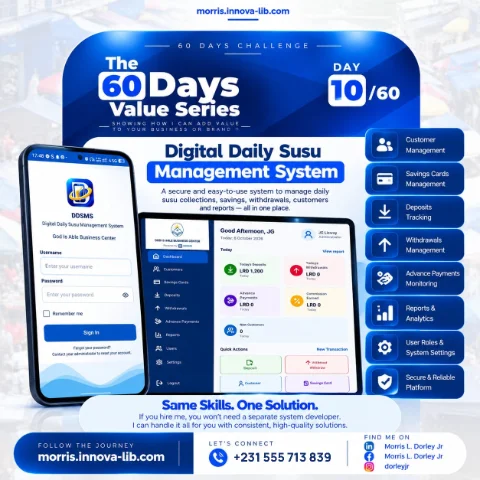

Day 10 of the 60 Days Value Series is about protecting people's savings with better records. If you hire me, you will not need a separate system developer. I build a secure and easy to use Digital Daily Susu Management System that manages daily susu collections, savings, withdrawals, customers and reports, all in one place.
Can you prove, today, how much each customer has saved?
Daily susu is built on trust. A customer hands over a small amount every day, sometimes for months, and expects to receive their savings back when the time comes. The collector or business owner carries a big responsibility: every deposit must be recorded correctly, every withdrawal must be accurate and every commission must be fair. When the records live on paper cards and in handwritten books, a single lost card, a smudged number or a forgotten entry can lead to arguments, lost trust and lost money.
This post is for susu business owners, collectors and community savings groups who want a susu management system in Liberia that makes every record clear, secure and quick to find, and who would rather work with one person who can design and build the whole system than coordinate several developers.

What is daily susu and why does it matter?
Susu is a form of community saving used across Liberia and West Africa. A customer agrees to save a fixed amount each day. The collector gathers the money, records each payment on the customer's savings card and, at the end of the saving period, returns the total to the customer after taking an agreed commission. For many market sellers, drivers, small traders and families, susu is the most reliable way to save, because it builds the habit of saving a small amount every single day and it makes money available later for rent, school fees, stock or an emergency.
That trust is valuable, and it is exactly why accurate records matter. A digital system protects the customer, who can see their savings clearly, and it protects the business, which can show exactly what happened.
A good record is not about suspicion. It is about making sure that everyone, the customer, the collector and the owner, agrees on the same numbers every day.
What goes wrong with paper susu records?
- Lost or damaged cards. Rain, wear and misplacement can destroy months of savings history.
- Calculation errors. Adding up many small daily amounts by hand leads to mistakes.
- Disputes. If a customer remembers a payment that the record does not show, there is no easy way to settle it.
- Slow reporting. The owner cannot easily see total deposits, withdrawals and commissions for a day or a month.
- Hard to supervise. With several collectors, it is difficult to know what each one has recorded.
- Hidden risk. Without a clear picture of cash, advances and commitments, the business can run into problems without warning.
What eight features does the Day 10 flyer cover?
The flyer lists eight parts of the system. Here is what each one does.
1. Customer management
Every customer has a profile: name, phone number, address, photo if needed, and the savings cards that belong to them. Staff can search for a customer in seconds and see their whole history, instead of searching through piles of cards. New customers are registered once, and the dashboard shows how many joined today.
2. Savings cards management
The digital savings card replaces the paper card. Each card has its saving amount, start date, status and balance. The system knows what has been paid and what is outstanding, so nobody has to count boxes on a card by hand. Cards can be created, tracked and closed with a clear record of each step.
3. Deposits tracking
Each daily deposit is recorded against the customer's card, with the date, amount and the staff member who received it. The dashboard shows today's deposits at a glance, so the owner can see collections as they happen instead of waiting for a handwritten summary at the end of the day.
4. Withdrawals management
When a customer withdraws savings, the system records the amount, the date and the person who approved it, and it updates the balance automatically. Rules can require approval for larger amounts. This keeps payouts accurate and gives you a clear trail if anyone ever asks questions.
5. Advance payments monitoring
Some susu businesses give customers an advance against their savings. This feature tracks each advance, how much has been repaid and what remains, so that the business does not lose track of money that is out in the community. The dashboard shows today's advance payments and the commission earned.
6. Reports and analytics
The system turns daily activity into clear reports: deposits, withdrawals, advances, commission earned and new customers, for any day or period. The owner can see how the business is performing without sitting down with a calculator. Printed or on screen reports can also be shared with partners or regulators when required.
7. User roles and system settings
Not everyone should be able to do everything. Roles let the owner decide who can record deposits, who can approve withdrawals, who can add users and who can see reports. System settings let you adjust things such as commission rules and business details. Each person signs in with their own username and password, so every action can be traced to a person.
8. Secure and reliable platform
Because the system handles people's money records, security and reliability come first: protected sign in, controlled access, careful data handling and a setup that is ready for regular backups. This is where my background as a Cloud Architect matters, because the technical foundation behind a financial record system has to be dependable.
What does a normal day look like with the system?
- Sign in. The collector opens the system on a phone or computer with their own username and password.
- Find the customer. They search by name or card and see the current balance.
- Record the deposit. They enter the amount and save. The card balance updates immediately.
- Handle a withdrawal if needed. The request is recorded and approved according to your rules.
- Close the day. The owner opens the dashboard, sees total deposits, withdrawals, advances and commission, and checks that the cash matches the records.
What used to take an evening of adding up numbers now takes a few minutes of checking.
How does the system protect your customers and your business?
- Clear history. Every deposit and withdrawal is saved with a date and a person.
- Accurate balances. The system calculates, so arithmetic mistakes disappear.
- Fewer disputes. If a customer questions a balance, you can show the full record.
- Controlled access. Only authorized people can approve sensitive actions.
- Better supervision. You can compare collectors and see the activity of each.
- A safer record. Digital data can be backed up, while a single paper card cannot.
How does one person who builds the whole system save you money?
A system like this needs interface design, a database, secure sign in, business rules for deposits and withdrawals, reports and hosting. Splitting those tasks across several people multiplies meetings and cost, and it increases the chance that something is misunderstood.
- One conversation. You explain how your susu business works once, and the system follows your rules.
- A system that matches your process. Commission, advances and card rules are built the way you actually use them.
- Faster changes. If you add a new type of savings card or report, I build it directly.
- One bill. You deal with one person instead of coordinating a team.
- A consistent look. The login screen, dashboard and reports share a clean, professional design, which builds customer confidence.
What technical foundation is behind the system?
A financial record system has to be right, not just attractive. I am a Cloud Architect and Full-Stack Developer with 90+ web applications built, and I have worked on platforms that serve thousands of users, including the Starz University app, which serves 15,000+ students and faculty with 99.9% uptime. That experience shapes how I build databases, sign in and hosting for systems where accuracy matters. See my skills, read about my experience, browse the case studies, view my projects and learn more about me. My database development and backend development pages explain this side of the work.
Who is this for?
- Daily susu business centers with many customers and several collectors.
- Individual susu collectors who want to grow and keep accurate records.
- Community savings groups and cooperatives that pool contributions.
- Small lenders and microfinance style businesses that track deposits and advances.
- Church, market and association savings groups that collect regular contributions.
How do you know it is time to go digital?
- You have more cards than you can safely keep track of.
- Customers sometimes disagree with the balance on their card.
- You spend hours each evening adding up the day.
- You cannot easily tell how much commission the business earned this month.
- You worry about what would happen if the record books were lost or damaged.
- You want to hire more collectors but cannot supervise them.
What mistakes should you avoid when digitizing a savings business?
- Switching overnight. Move customers over carefully and check balances against the paper cards.
- Sharing one login. Give each person their own account so actions can be traced.
- Skipping backups. Save copies of the data regularly in a second safe place.
- Making the system too complicated. Collectors need quick, simple screens.
- Forgetting training. Staff need practice before the system goes live.
- Choosing by price alone. A system that handles money must be accurate and secure.
What affects the price of a susu management system?
Every business is different, so I price to the scope. These things shape the price:
- The number of staff users and roles.
- Which features you need at launch and which can come later.
- Whether you want phone access for collectors, a desktop dashboard or both.
- How many existing customers and cards must be imported.
- How much training and support you want.
Send me your goals and I will reply with a clear quote.
How does it work?
- Send your brief. Tell me how your susu business runs, including saving amounts, commission and advances.
- Get a plan and quote. I define the features, screens, timeline and price.
- I design and build. You review the system with sample data and we adjust the rules.
- We move your records in. Existing customers and card balances are imported and checked against your paper records.
- Training and launch. I train your staff, set up roles and backups, and remain available for support.
Which search terms does this post answer?
If you arrived here from Google, you may have searched for one of these: susu management system Liberia, susu software, daily susu app, savings collection software for Africa, how to digitize a susu business, community savings management system, microfinance software for small businesses in Liberia, or system developer in Monrovia. The answer to all of them is the same: send me your brief and I will give you a clear plan and quote.
Ready to protect your customers' savings with a proper system?
You do not need a database designer, an interface designer, a security specialist and a report builder working separately. Message me on WhatsApp at +231 555 713 839 or visit the contact page, tell me how your susu business works, and I will respond with the next step. Same skills, one solution, with consistent, high quality work you can trust every day.
Tomorrow, Day 11 continues the series. Follow the journey on the blog, Facebook, Instagram and LinkedIn.
Frequently asked questions
What is susu?
Susu is a community savings practice found across Liberia and West Africa. A collector visits customers or receives them at a business center and gathers a small amount of money each day. The money is recorded on the customer's savings card, held safely, and returned to the customer later, usually after the collector keeps an agreed commission.
What is a digital susu management system?
It is software that replaces the paper cards and record books used in a susu business. Customers, savings cards, daily deposits, withdrawals, advance payments and commissions are all recorded in one secure system, and reports are produced automatically.
Who is this system for?
Susu collectors, susu business centers and community savings groups that serve many customers and want accurate records. It helps most when the number of customers is too large to manage safely in notebooks.
What can the system track?
The Day 10 flyer lists the main features: customer management, savings cards management, deposits tracking, withdrawals management, advance payments monitoring, reports and analytics, user roles and system settings, and a secure and reliable platform.
Can several staff members use it?
Yes. User roles let you decide who can record deposits, who can approve withdrawals and who can see reports, so the owner stays in control and every action is traceable.
Will it work on a phone?
The flyer shows a phone sign in screen and a management dashboard on a tablet or laptop. I can build the system so that staff can work from a phone or a larger screen, depending on how your collectors work.
Is my customers' money information safe?
Security is a core requirement. I build secure sign in, role based access and careful record keeping, and I recommend regular backups. No system is a substitute for good management, but a digital record is much harder to lose, alter or dispute than a paper card.
How much does a susu management system cost in Liberia?
The price depends on the number of users, the features you need, whether you want mobile access and how much existing data must be moved in. Send your details on WhatsApp at +231 555 713 839 and I will give you a clear quote for the exact scope.
Do you work outside Monrovia and outside Liberia?
Yes. I work with clients in Monrovia, across Liberia and across Africa, remotely or in person.