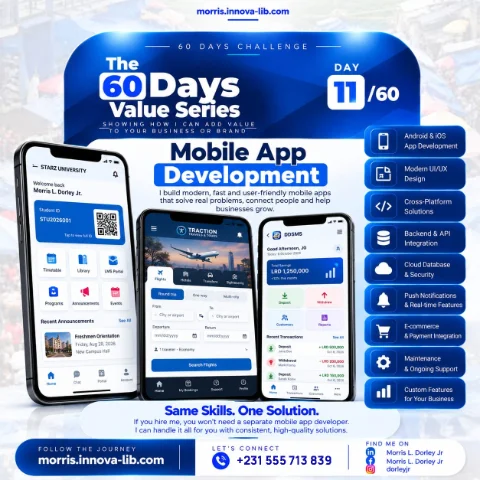

Day 11 of the 60 Days Value Series is about mobile apps. If you hire me, you will not need a separate mobile app developer. I build modern, fast and user friendly mobile apps that solve real problems, connect people and help businesses grow, and I handle the design, the app, the backend, the cloud and the support myself.
Is your customer's phone the best place to meet them?
Think about how people in Liberia and across Africa use technology. The phone is the main computer for most of them. They use it to talk, to pay, to learn, to shop, to check information and to follow what is happening around them. When a business, a school or an organization puts its services into a well made app, it meets people in the place where they already spend their day.
This post is for business owners, school leaders, organizations and startups who are asking, "Should we have an app, and who can build it?" It explains what a good mobile app involves, what the Day 11 flyer covers and why one capable person who handles every part of the project can deliver more value than a team of separate specialists. If you are searching for a mobile app developer in Liberia, this is for you.

What does building a mobile app really involve?
A mobile app looks like a few screens, but several layers must work together:
- Design. The look, the layout and the way people move through the app, so that it feels natural.
- The app itself. The code that runs on the phone and responds to taps, forms and swipes.
- The backend. The server that checks logins, stores information and applies your business rules.
- The database. The secure place where users, records and transactions are kept.
- Connections. Integrations with payment services, messaging and other tools through APIs.
- Release and support. Publishing the app, fixing problems and keeping it up to date.
In many companies each layer has its own specialist. That means more meetings, more delays and more chances for the pieces not to fit. When one person understands every layer, the pieces are designed to fit from the beginning.
A good app is not a collection of screens. It is a complete service: simple on the phone, dependable behind the scenes and supported long after launch.
What nine services does the Day 11 flyer cover?
The flyer lists nine parts of the mobile app service. Here is what each one means for you.
1. Android and iOS app development
Android phones are very common in Liberia, and iPhones matter for many professionals and for audiences abroad. I build apps that run well on both, so you can serve all of your users and not only half of them.
2. Modern UI and UX design
UI is how the app looks. UX is how it feels to use. I design clean screens with clear buttons, readable text and a simple flow, so that a new user understands what to do in seconds. The example screens on the flyer show this approach: a welcome screen, a grid of easy to recognize icons, clear sections for recent information and a bottom bar for quick movement. Because I am also a graphic designer, the app matches your brand.
3. Cross-platform solutions
Cross-platform development lets one main project produce an app for both Android and iOS. That usually means lower cost, faster delivery and easier updates, because a change is made once instead of twice. I recommend it for most business apps and explain the few cases where building separately is worth the extra effort.
4. Backend and API integration
Behind every useful app is a backend that remembers things: who the user is, what they have paid, what they have booked and what has changed. I build the backend and connect the app to it through an API, which is the doorway that lets the phone and the server talk to each other. I can also connect existing systems, such as a database you already use.
5. Cloud database and security
User information must be stored safely. I set up the cloud database and apply sensible security: protected sign in, controlled access, encrypted connections and a plan for backups. This is where my background as a Cloud Architect helps most, because an app is only as trustworthy as the infrastructure under it.
6. Push notifications and real-time features
Notifications bring users back with timely information, such as an announcement, a reminder, a confirmation or a new offer. Real time features keep screens up to date without refreshing, for example new messages, live balances or booking status. These features make an app feel alive and useful.
7. E-commerce and payment integration
If your app sells products or services, it needs a smooth way to order and pay. I build the catalogue, the cart and the checkout flow and connect payment options that are supported for your market. Orders and payments appear in your records so you always know what was sold and what was received.
8. Maintenance and ongoing support
Phones update, users find edge cases and businesses change. I provide fixes, updates and improvements after launch, so the app does not slowly stop working. You always know who to contact.
9. Custom features for your business
Every organization is different. Some need a student ID with a QR code, some need bookings, some need savings and transaction tracking. I build features around your process instead of forcing your process into a generic app.
What kinds of apps are possible?
The flyer shows three example apps on three phone screens, each solving a different real problem:
- A university app. A student view with a digital student ID and QR code, quick access to a timetable, library, learning portal, programs, announcements and events. This reflects my work on the Starz University app, which serves 15,000+ students and faculty with 99.9% uptime. You can read the full story in the Starz University case study.
- A travel app. Flight, hotel, transfer and sightseeing search, with a place to see bookings and support. It pairs with the booking platform described on Day 8 of this series.
- A savings and transactions app. A view of total savings, deposits, withdrawals, customers and recent transactions. It pairs with the susu management system described on Day 10.
Other common ideas include delivery and ordering apps, church and community apps, school and parent communication apps, appointment booking, inventory tools for shops, and apps for NGOs that collect field data.
Do you really need an app, or would a website be enough?
An honest answer saves you money. A mobile app is a good choice when people will use your service often, when you need notifications, when users sign in and keep personal information, or when features such as a camera, a QR code or offline access matter. A website is often enough when you mainly need to present information or receive enquiries. Day 9 explains how a good website works. Many businesses start with a website and add an app later, and I will advise you on the path that fits your goals and your budget instead of selling you the most expensive option.
Why do many app projects fail?
- No clear problem. An app built because competitors have one, without a purpose, is rarely used.
- Too many features at once. The first version becomes slow, expensive and confusing.
- Poor design. If users cannot understand a screen quickly, they uninstall the app.
- Weak backend. An app that is slow, crashes or loses data destroys trust quickly.
- Ignoring local conditions. Data costs, slow connections and older phones are real, so apps must be light and forgiving.
- No support after launch. The developer disappears and the app stops working with the next phone update.
- Handoffs between teams. The designer, the app developer and the backend developer each build something slightly different.
How does one person who does it all save you money?
- One brief. You explain your idea once to the person who will build it.
- No translation loss. The designer, the app developer and the backend developer are the same person, so the design is built as drawn.
- Faster decisions. Changes do not wait for several people to agree.
- Lower total cost. You pay for the building, not for the coordination.
- Joined up quality. The app, the database, the notifications and the payments are designed together.
- One person to hold accountable. If something fails, there is no finger pointing.
What technical foundation is behind the work?
I am a Cloud Architect and Full-Stack Developer with 90+ web applications built, and I have delivered systems for thousands of users, including the Starz University app and cloud migration that cut operating cost by 90%. That mix of cloud, backend and front end skills is what lets one person deliver a whole app and not just a few screens. See my skills, read about my experience, browse the case studies, view my projects and learn more about me. The full-stack development and backend development pages give more detail.
Who is this for?
- Universities, schools and training centers that want a student and parent app.
- Businesses and shops that want ordering, loyalty or customer service on the phone.
- Financial and savings groups that want secure transaction apps.
- Travel, transport and hospitality companies that want bookings in an app.
- NGOs and churches that want to inform and connect their communities.
- Startups that want to test a mobile idea with a solid first version.
How do you know you are ready for an app?
- You can name the main problem the app would solve.
- You know who the first users are and what they need to do.
- Your users already own smartphones and use them daily.
- You have a process that would benefit from notifications or quick access.
- You are ready to begin with a focused first version and improve it.
What mistakes should you avoid when planning an app?
- Trying to build everything in version one. Launch with the features that matter most.
- Skipping real user feedback. Test with a few real users before a full launch.
- Forgetting offline and low data situations. Keep the app light.
- Neglecting security. Protect sign in and personal data from the start.
- Not budgeting for support. Plan for updates and fixes.
- Choosing only by price. The cheapest builder who disappears costs the most.
What affects the price of a mobile app?
Every project is different, so I price to the scope. These things shape the price:
- The number of screens and features.
- How much backend and database work is needed.
- Whether you need Android, iOS or both.
- Integrations such as payments, notifications and existing systems.
- How much design work and ongoing support you want.
Send me your idea and I will reply with a clear quote.
How does it work?
- Send your brief. Tell me the problem, the users and the features you imagine.
- Get a plan and quote. I define the first version, the timeline and the price.
- Design first. You see the screens before they are built and can adjust the flow.
- I build and connect. I develop the app, the backend and the database, and share working builds to test.
- Launch and support. I help publish the app and remain available for updates and improvements.
Which search terms does this post answer?
If you arrived here from Google, you may have searched for one of these: mobile app developer Liberia, Android app development Liberia, iOS app developer in Africa, app developer in Monrovia, cross-platform app for a business, build a university app, how much does an app cost in Liberia, or hire an app developer with backend skills. The answer to all of them is the same: send me your brief and I will give you a clear plan and quote.
Ready to put your service in your customers' pockets?
You do not need a designer, an app developer, a backend developer and a cloud engineer working separately. Message me on WhatsApp at +231 555 713 839 or visit the contact page, tell me about your idea, and I will respond with the next step. Same skills, one solution, with consistent, high quality work that helps your business grow.
Tomorrow, Day 12 continues the series. Follow the journey on the blog, Facebook, Instagram and LinkedIn.
Frequently asked questions
What does a mobile app developer do?
A mobile app developer designs and builds apps that run on phones and tablets. That includes the screens people use, the logic that makes the app work, and the server and database behind it that store information and send it to the right users. I handle all of those parts myself.
Can you build for both Android and iOS?
Yes. The Day 11 flyer lists Android and iOS app development and cross-platform solutions. A cross-platform approach lets one project serve both kinds of phones, which usually saves time and cost compared with building two separate apps.
Why would my business need a mobile app?
An app can give customers or members a faster, more convenient way to use your services: view information, make requests, receive notifications, pay and track activity. It works best when it solves a clear problem, such as bookings, student services, collections or orders. If a website would be enough, I will tell you honestly.
Do you build the backend and database as well?
Yes. Most useful apps need a backend that stores data, handles logins and talks to other services through an API. I build and connect that part, and I set up the cloud database and security, so you do not need a separate backend developer.
What are push notifications and real time features?
Push notifications are short messages that appear on a user's phone, such as an announcement or a booking confirmation. Real time features update information instantly, such as new messages or changing balances. Both keep users engaged and informed.
Can the app accept payments?
E-commerce and payment integration is part of the service. The payment methods depend on the providers available for your market and are agreed together during planning. I only connect options that are properly supported.
How much does a mobile app cost in Liberia?
The price depends on the number of screens, the features, the backend work, the platforms and the level of support you want. Send your details on WhatsApp at +231 555 713 839 and I will give you a clear quote for the exact scope.
Will you maintain the app after it launches?
Yes. Apps need updates for new phone versions, fixes and new features. Maintenance and ongoing support are part of the service.
Do you work with clients outside Monrovia and outside Liberia?
Yes. I work with clients in Monrovia, across Liberia and across Africa, remotely or in person.