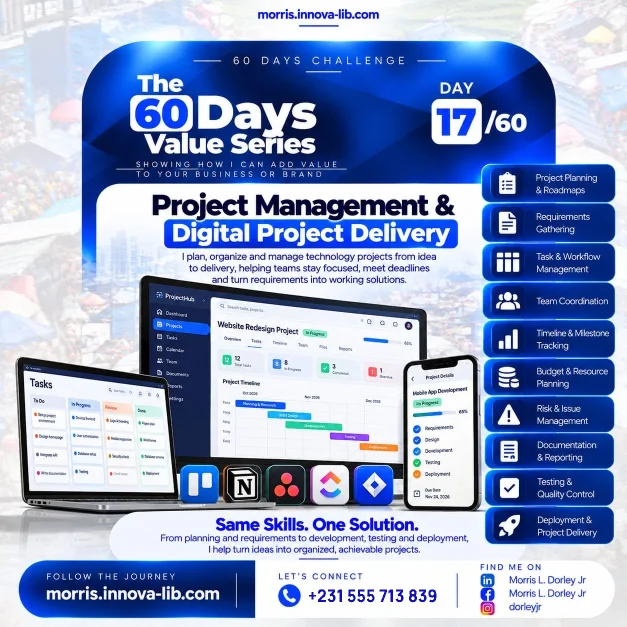

Day 17 of the 60 Days Value Series is about project management and digital project delivery. I plan, organize and manage technology projects from idea to delivery, helping teams stay focused, meet deadlines and turn requirements into working solutions.
Why do so many technology projects finish late or never finish at all?
Almost everyone who has paid for a website, an app or a software system has a story about it. It took twice as long as promised. It cost more than agreed. The final result was not what they pictured. Or it simply never launched, and the money was gone.
In most of these stories, the technology was not the problem. The developers could code, the designers could design. What was missing was someone whose job was to keep the whole project moving in one direction: to agree what was being built, to break the work into steps, to keep track of time and money, and to make sure the result was tested and delivered.
That is project management, and it is the difference between a good idea and a finished product. This post is for business owners, school leaders, church and NGO administrators, startup founders, shop owners and anyone asking, "How do I get my technology project finished properly, and who can manage it?" If you are searching for project management in Liberia or an IT project manager in Monrovia, this is for you.

What is project management in plain language?
Project management is the work of getting something built on time, within budget and to the quality you expected. It answers six simple questions:
- What are we building? A clear description everyone agrees on.
- Who is doing what? Every task has an owner.
- When will each part be ready? Dates and milestones you can check.
- How much will it cost? A budget that is tracked, not guessed.
- What could go wrong? Risks listed early, not discovered late.
- How do we know it works? Testing before launch, not after.
When these questions have clear answers, projects feel calm. When they do not, projects feel like constant emergencies.
A project without a plan is a series of surprises. A project with a plan, a tracker and one person responsible for it is a series of small, manageable steps that end in a launch.
What ten services does the Day 17 flyer cover?
The flyer for Day 17 lists ten services. Together they cover the full journey of a technology project, from the first idea to the day it goes live.
1. Project planning and roadmaps
Everything starts with a plan. A roadmap shows the big stages of the project, what comes first, what depends on what and when each stage should finish. It gives you and your team a shared picture, so nobody is guessing what happens next. A simple, honest roadmap is worth more than a long document no one reads.
2. Requirements gathering
Before anything is built, we write down what it must do. Who will use it? What problems does it solve? What must be included now and what can wait? Clear requirements prevent the most expensive mistake in technology: building the wrong thing. This is also where ideas become specific enough for developers and designers to build, which connects directly to the work in Day 8 on booking systems and Day 10 on susu management software, where clear requirements decided the result.
3. Task and workflow management
Big projects are finished one small task at a time. I break the project into tasks, assign each one, set a due date and track it on a simple board that shows what is to do, in progress and done. Anyone on the team can open the board and see exactly where things stand, without a long meeting or a chain of messages.
4. Team coordination
Projects usually involve several people: a designer, a developer, a writer, a client, sometimes outside suppliers. Coordination means everyone knows what they need to deliver, who they depend on and who depends on them. Regular short check-ins keep small misunderstandings from becoming big delays.
5. Timeline and milestone tracking
Milestones are the checkpoints along the way: design approved, first version ready, testing complete, launch day. Tracking them means you always know whether the project is on time, and if it is slipping, you find out early, while there is still time to fix it. Early warning is one of the most valuable things a project manager provides.
6. Budget and resource planning
Money, people and time are limited. Budget and resource planning decides how they are used, so the most important work gets done first and nothing is paid for twice. As the project moves, spending is tracked against the plan, and any change to the scope is discussed and priced before it is added, never after.
7. Risk and issue management
Every project has risks: a supplier may be late, a requirement may change, a team member may be unavailable, the power or internet may fail at the wrong moment. Risk management means listing these early and deciding what to do if they happen. Issue management means that when a problem does appear, it is recorded, someone owns it and it gets solved quickly. Planning for problems is what keeps them small.
8. Documentation and reporting
Good documentation protects your investment. It records what was built, how it works, the decisions made and the passwords and settings you will need later. Simple, regular reports tell you what was done this week, what is next and what needs your decision. You are never left wondering what you paid for.
9. Testing and quality control
A project is not finished when the last feature is built. It is finished when it works properly for real people. Testing means trying the product the way users will, on the phones, computers and internet connections they actually use, and fixing what breaks. Quality control means checking the work against the requirements we agreed at the start.
10. Deployment and project delivery
Launch day should be calm. Deployment means moving the finished product to where real users can reach it, with a checklist so nothing is forgotten. Project delivery means a proper handover: access, documentation, training and support, so you can run what was built with confidence. This links closely to Day 12 on system administration, which keeps what was delivered running smoothly.
Which tools help keep a project organized?
The flyer shows popular planning and task tools, including boards and note-based workspaces such as Trello and Notion. The tool is less important than the habit of using it. A project board that is updated every day beats an expensive system nobody opens.
I choose tools that fit your team. A small team may only need a simple task board and a shared document. A larger project may need a timeline view and a shared calendar. The goal is always the same: one place where anyone can see what is happening.
Who is this service for?
Anyone running a project that involves technology, money and deadlines can benefit:
- Business owners. Launching a website, an online shop, a booking system or a new internal tool.
- Startups and founders. Turning an idea into a first working product without wasting limited funds.
- NGOs and organizations. Delivering digital projects with donor reports, deadlines and clear accountability.
- Schools and training centers. Setting up portals, networks and learning systems.
- Churches and community groups. Managing websites, media systems and event technology.
- Companies with a stuck project. Rescuing work that started well and lost direction.
- Teams with developers but no manager. Adding the planning and coordination that keeps good developers productive.
Why do projects fail?
Technology projects usually fail for reasons that have little to do with technology:
- Unclear requirements. Nobody wrote down what the product must do, so everyone imagined something different.
- No clear owner. Everybody is involved and nobody is responsible.
- Unrealistic deadlines. Dates were chosen to please, not based on the real amount of work.
- Scope creep. New requests are added again and again, and the project never ends.
- Hidden problems. Issues are discovered only at the end, when they are most expensive to fix.
- Weak communication. Messages are lost, decisions are forgotten and people repeat work.
- Skipped testing. The product goes live with problems that real users find first.
- No handover. The builder leaves, and the owner cannot manage what was built.
Every one of these can be prevented with a clear plan, regular tracking and one person responsible for the whole result.
How does one person who does it all save you money?
On a typical project, planning, requirements, coordination, testing and delivery are handled by different people, or by nobody at all. Each handover loses information, and each missing role becomes a gap in which problems grow.
With one person, you get:
- One plan. The requirements, the schedule, the budget and the tests all come from the same understanding.
- One point of contact. You always know who to ask, and nothing falls between roles.
- Technical understanding. Because I also build websites, apps, systems and networks, I know what is realistic, so the plan is honest from the start.
- Less waste. Time and money go to the work that matters, not to rework and meetings.
- Clear costs. One scope, one budget and clear approval for any change.
This is the idea behind the whole 60 Days Value Series: the same skills, one solution, applied to the part of your business you are looking at today.
How does project management connect to the rest of this series?
Project management is the thread that ties many of the other skills together. A website like the one described in Day 9 needs requirements, content, design, testing and launch. A mobile app, as in Day 11, needs a roadmap and careful testing on real phones. An online shop, as in Day 14, needs products, payments and delivery planned together. A security system, as in Day 15, needs an assessment, installation and handover. And a promo video, as in Day 16, needs a script, scenes and approvals before any animation begins.
You can also read the service pages for full-stack development and maintenance and support, because a well-managed project continues with proper support after launch.
How do you know it is time for a project manager?
Look for these signs:
- Your project has no clear dates, or the dates keep moving.
- You are not sure what has been done and what is left.
- Different people give you different answers about the same task.
- The budget is growing and nobody can explain why.
- You are the only person holding everything together, and it is exhausting.
- The project started well and then stalled.
- You are about to start something big and want to avoid the usual mistakes.
If several of these sound familiar, a short planning session is a sensible first step.
What mistakes should you avoid when starting a project?
- Starting to build before the requirements are clear. Time spent on clarity at the start saves many times that later.
- Trying to include everything in the first version. Launch the most useful part first, then improve.
- Agreeing to deadlines without checking the work. A realistic date is better than a hopeful one.
- Hiding bad news. Problems found early are cheap. Problems found late are not.
- Changing the scope without changing the plan. Every addition affects time and budget, so decide on both together.
- Skipping testing to save time. Your users will do the testing for you, and they will not be kind.
- Forgetting the handover. A project is only complete when you can run it without the builder.
What affects the price of project management?
There is no single price, because every project is different. The main factors are:
- The size and complexity of the project.
- How long the project will run.
- The number of people and suppliers to coordinate.
- Whether you need full management or planning and review only.
- How much documentation, reporting and testing is needed.
- Whether deployment, training and handover are included.
I would rather give you a clear quote for the right scope than a vague number that changes later. Send me the details and I will explain what is needed and why.
How does it work?
- Tell me about your project. Share the idea, the goal, the deadline and what has been done so far.
- Plan and define. We agree the requirements, the roadmap, the milestones and the budget.
- Organize and assign. Tasks are set up on a simple board and every person knows their part.
- Build, track and report. The work moves forward with regular updates, and risks and issues are handled as they appear.
- Test and fix. The product is tested against the requirements and problems are resolved before launch.
- Deliver and hand over. The product is deployed, documented and handed over with the support you need.
Which search terms does this post answer?
If you have searched for any of these, this post was written for you:
- project management in Liberia
- IT project manager in Monrovia
- how to manage a website or app project
- software project management for African businesses
- requirements gathering for a new system
- project plan and roadmap for a startup
- how to keep a technology project on budget
- why do IT projects fail
- digital project delivery services
- hire a project manager in Liberia
Ready to get your project finished?
You do not need one person to plan, another to track, another to test and another to deliver. You need one capable person who understands the technology, keeps everyone aligned and stays until it is done. That is what I offer.
Message me on WhatsApp at +231 555 713 839 or use the contact page, tell me about your project, and I will give you a clear plan and a clear quote. Same skills. One solution.
Frequently asked questions
What does a project manager actually do on a technology project?
A project manager turns an idea into a plan and then keeps the plan moving. That means agreeing what is being built, breaking the work into tasks, setting dates, coordinating the people involved, watching the budget, spotting problems early and making sure the finished product is tested and delivered properly.
I already have a developer or a team. Do I still need project management?
Very often yes. Good developers build what they are told, and the project fails when nobody has clearly decided what to build, in what order and by when. Project management gives your team a clear plan, clear priorities and one person who keeps everyone aligned.
What is requirements gathering?
It is the step where we write down exactly what the project must do, who will use it and what success looks like, before any building starts. Clear requirements prevent the most expensive problem in technology projects: building the wrong thing.
Can you manage a project that has already started and is stuck?
Yes. I can review where the project stands, list what is done and what is left, reset priorities, agree a realistic timeline and get the team moving again. Many stuck projects need clarity more than they need more people.
Which tools do you use to track work?
I use simple task and planning boards, calendars, documents and shared roadmaps, with tools such as Trello and Notion shown on the flyer. The tool matters less than the habit, so I choose something your team will actually use.
How do you keep a project on budget?
By agreeing the scope early, planning the budget and resources against that scope, tracking spending as the work progresses and raising any change before it becomes a surprise. Every change is discussed, priced and approved before it is added.
What happens when something goes wrong during a project?
Risk and issue management means problems are expected and planned for. We list likely risks at the start, watch them during the project and agree what to do if one happens. When an issue appears, it is recorded, owned by someone and solved quickly.
How much does project management cost in Liberia?
The price depends on the size of the project, how long it will run, the number of people involved and how much hands-on management you need. Send your details on WhatsApp at +231 555 713 839 and I will give you a clear quote for the exact scope.
Do you work with clients outside Monrovia and outside Liberia?
Yes. Planning, tracking and coordination work well online, so I manage projects for clients in Monrovia, across Liberia and across Africa, with regular updates and reviews.